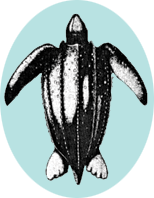
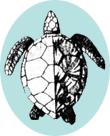
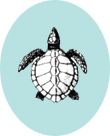
Leatherback (Dermochelys coriacea) Leatherbacks are the largest sea turtles in the world and are
the species most commonly seen in southern New England waters. They can reach lengths of 8 feet and can weigh up to 1500 pounds.
Leatherbacks are readily identified by their large size and the fore-and-aft ridges which run along the carapace (upper shell).
Fishermen and boaters often report seeing a leatherback’s large head, which can resemble a seal’s head from a distance, lifted above the surface. They feed primarily on jellyfish. Leatherbacks have the ability to generate their own heat,
allowing them to swim in much colder water than do other sea turtles. Entanglement in fishing/lobstering gear is a threat
to leatherbacks, when they can not get to the surface to breathe. They are known to ingest plastic trash, which can be fatal.
See photos of free-swimming leatherbacks.
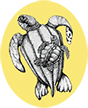
Loggerhead (Caretta caretta) Loggerhead sea turtles are dark brown to reddish brown in color, sometimes
described as the color of a wet paper grocery bag. Most loggerheads seen in southern New England waters are juveniles, ranging
in length from 15 to 36 inches, weighing from 25 to 100 pounds. They feed on hermit and spider crabs, mussels and moon snails.
See photos of free-swimming loggerheads.
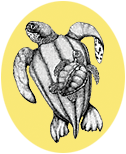
Kemp's ridley (Lepidochelys kempi) Kemp’s ridleys are the smallest and most endangered of all sea turtles
in the world. Only juveniles have been reported in southern New England waters, ranging in length from 12 to 15 inches, weighing
approximately 5 pounds. They eat mainly crabs, but may also eat fish, jellyfish and mollusks.
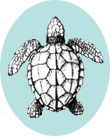
Green turtle (Chelonia mydas) Green sea turtles are not green, but rather are brown or mud-colored with a mottled carapace.
Their name is derived from the color of their fat. Only juveniles have been found in New England waters, ranging from 12 to 20 inches long,
weighing about 10 pounds. Green turtles are mostly herbivorous, feeding primarily on sea grasses and algae.